


 Strategy Beats Hard Work
Many aspirants spend hundreds of hours studying, yet their scores remain stagnant because they prepare without strategy. Success in CAT comes from knowing what to study, how to study, when to attempt, and when to skip. Hard work builds knowledge, but strategy converts knowledge into percentile.Based on recent CAT trends, scoring around 50% of the total marks is often enough to secure a 99 percentile (the exact score varies every year depending on the paper’s difficulty and overall performance). This means you don’t need to solve every question—you need to solve the right questions with high accuracy.A 99 percentile becomes much more achievable when you break it down into smaller, section-wise goals.
Instead of thinking about clearing an entire paper, focus on consistently crossing the 50% mark in each section. This makes the target feel realistic and helps you prepare with clarity rather than anxiety.
Note: The exact number of attempts required changes every year depending on the exam’s difficulty and the accuracy of those attempts. Treat these numbers as practical benchmarks, not fixed cut-offs.
Section-Wise Strategy for CAT EXAM
1. VARC: Reading Comprehension is Non-Negotiable
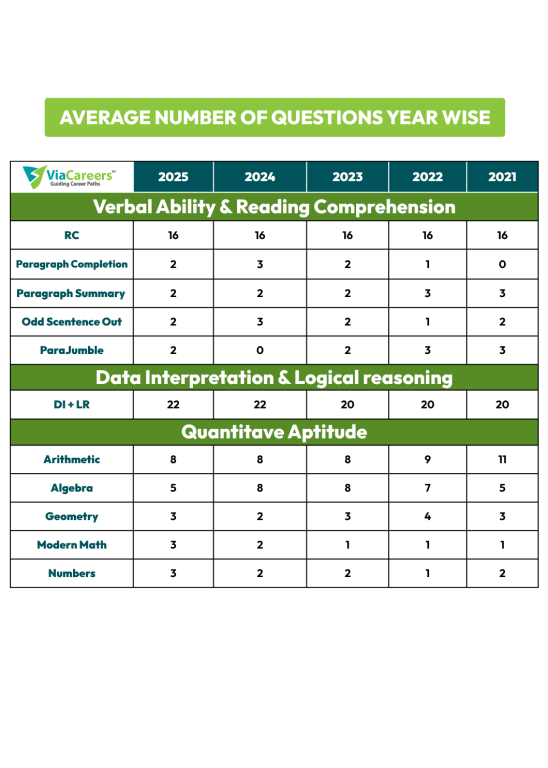
Over the past few years, Reading Comprehension has consistently contributed the majority of questions in the VARC section. With approximately 16 out of 24 questions coming from RC passages, this is an area you simply cannot ignore. Instead of memorising vocabulary lists, develop the habit of reading editorials, understanding arguments, identifying the author’s tone, and drawing logical inferences. Strong reading skills not only improve speed but also reduce silly mistakes. If your Reading Comprehension is strong, you’ve already covered a significant portion of the section.
2. DILR: Don’t Separate DI and LR
One of the biggest mistakes aspirants make is preparing Data Interpretation and Logical Reasoning as two completely separate subjects. In the actual CAT exam, sets are often integrated. A single set may require logical reasoning, numerical interpretation, and analytical thinking together. Instead of asking whether a set is DI or LR, train yourself to identify which sets are worth attempting first. Build the habit of solving a wide variety of mixed sets so that your selection skills become as strong as your solving skills. Remember, in CAT, choosing the right set is often half the battle.
3. Quant: Prioritise Arithmetic and Algebra
When you analyse recent CAT papers, one trend becomes impossible to ignore: Arithmetic and Algebra dominate the Quant section. Together, these two topics regularly account for more than half of the questions in most slots. This doesn’t mean you should ignore Geometry, Number System, or Modern Mathematics. However, if your objective is to maximise your percentile in the available preparation time, mastering Arithmetic and Algebra gives you the highest return on investment. A smart aspirant doesn’t try to master everything at once—they master the topics that contribute the most marks first.
Preparation Without Analysis Is Incomplete Many students believe that giving more mocks automatically improves their score. It doesn’t. The real improvement begins after the mock ends.
Analyse every mock carefully:
* Which questions should you have skipped?
* Where did you lose accuracy?
* Which topics consumed the most time?
* Could you have selected better DILR sets?
Each mock is feedback. The students who improve the fastest are the ones who spend as much time analysing their mocks as they do writing them.
Final Thoughts
A 99 percentile is not reserved for a handful of extraordinary students. It is achievable for aspirants who understand the exam pattern, prepare strategically, and execute their plan with discipline.
At ViaCareers, we believe success in CAT isn’t about attempting every question—it’s about making the right decisions under pressure. Build your preparation around the exam’s actual pattern, focus on high-impact topics, and stay consistent. That’s how percentile follows preparation.