

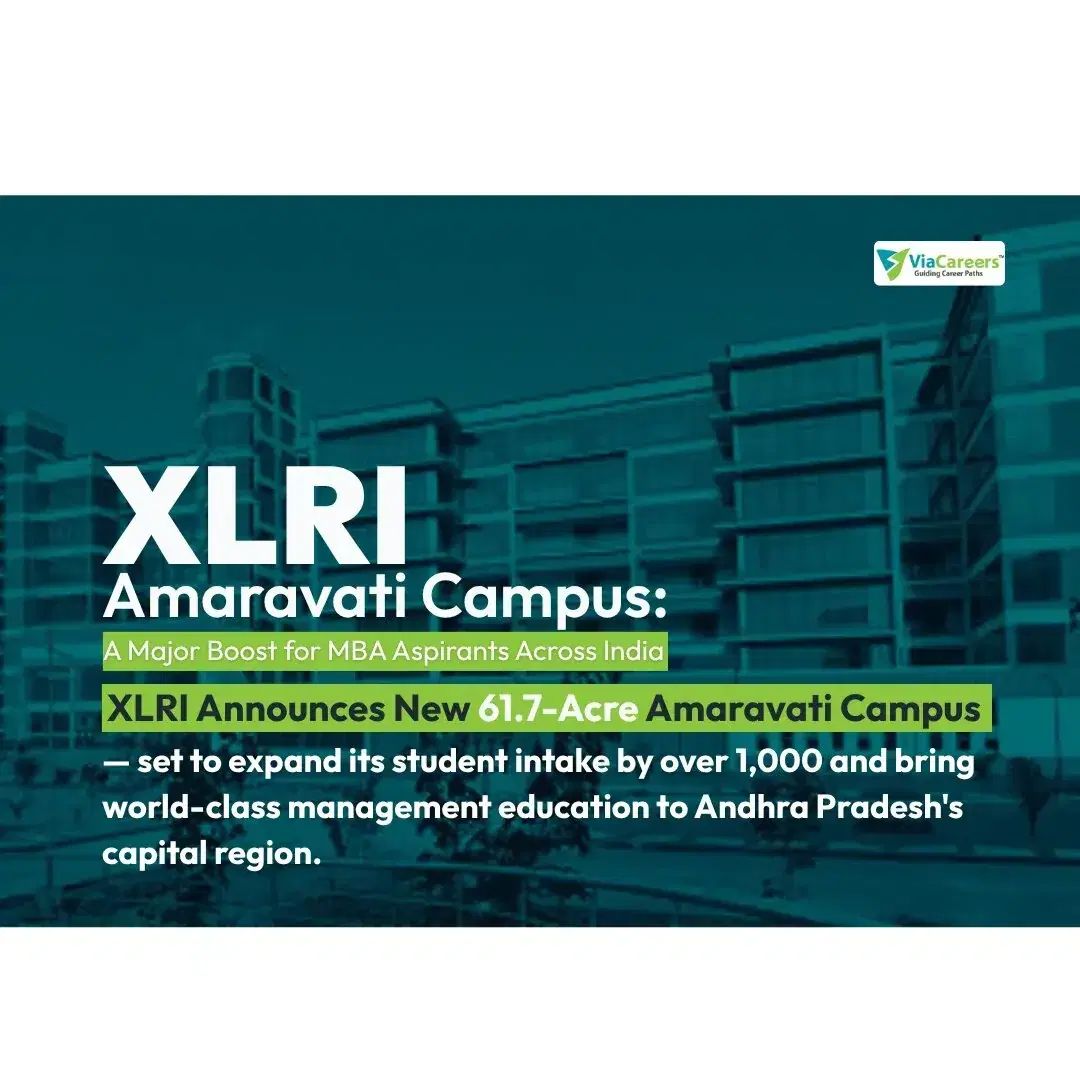
In a development that signals a bold new chapter for management education in peninsular India, XLRI – Xavier School of Management has formally signed an agreement with the Andhra Pradesh Capital Region Development Authority (APCRDA) to establish a sprawling new campus in Amaravati, the state's emerging capital. The agreement, inked on March 13, 2026, sets in motion one of the most significant academic infrastructure projects in the region in recent years — and a major opportunity for CAT 2026 aspirants.
The new campus will span 61.7 acres in Amaravati's capital region and represents an estimated investment of ₹300 crore — a figure that underscores the institution's serious, long-term commitment to its southern expansion. For XLRI, an institution with deep roots in Jamshedpur and decades of academic prestige, this is more than a new address. It is a deliberate push to widen the geography of quality management education in India — and crucially, increase access for future MBA candidates.
Phase 1: Expanding Opportunities at Scale
The first phase of the Amaravati campus is designed to accommodate over 1,000 full-time students, while simultaneously running executive education programmes for 200 working professionals. This dual structure — catering to both fresh graduates and mid-career executives — reflects a nuanced understanding of the demand landscape in South India.
For CAT 2026 aspirants, this is a game-changer. More seats at a top-tier B-school like XLRI directly translate into better admission odds without compromising on quality.
A Campus of Infinite Goodness
XLRI has conceptualised the Amaravati campus as a "Campus of Infinite Goodness" — a vision that goes beyond infrastructure. The campus is envisioned as a futuristic, smart, and sustainable academic environment, built to global accreditation standards.
Expect technology-enabled classrooms, collaborative innovation spaces, and an architectural ethos rooted in ethical leadership and sustainability — core principles that XLRI has always stood for.
Why Amaravati? A Strategic Move
The choice of Amaravati is deliberate and strategic. As Andhra Pradesh's planned capital city, Amaravati has been steadily positioning itself as a hub for governance, education, and innovation. For an institution like XLRI, whose Jesuit values have always emphasised service and social responsibility alongside academic rigour, Amaravati offers fertile ground — a young, ambitious city that mirrors the institution's own forward-looking character.
What This Means for CAT 2026 Aspirant
For management aspirants across South India — and indeed the India — this announcement carries substantial weight. XLRI's reputation for producing industry-ready leaders, its strong alumni network, and its emphasis on values-based management have long made it one of the most coveted B-schools in the country. A new campus that adds over 1,000 seats means greater access to that legacy, closer to home for thousands of students from Andhra Pradesh, Telangana, Tamil Nadu, and Karnataka.
A new campus that adds over 1,000 seats means greater access to that legacy, closer to home for thousands of students from Andhra Pradesh, Telangana, Tamil Nadu, and Karnataka. For CAT 2026 candidates especially, this expansion could ease competition marginally while maintaining XLRI’s elite status.
The executive education arm, designed for 200 working professionals, also signals intent to serve the region's corporate community — offering structured, high-quality upskilling pathways from an institution with genuine academic credibility. As Amaravati and its surrounding region continue to attract investment and industry, the timing of this campus could hardly be better.
A Transformational Shift in India’s MBA Landscape
XLRI's Amaravati expansion reflects a broader shift in India's education landscape — where top institutions are expanding beyond traditional strongholds to democratize access.
For decades, many South Indian aspirants had to travel far north for premier management education. This new campus changes that equation. It not only reduces geographic barriers but also strengthens Amaravati’s position as an emerging knowledge and innovation hub.
In the years ahead, this move could do far more than just add seats — it could reshape regional aspirations, retain local talent, and inspire a new wave of institutions to follow suit. What begins as a campus today has the potential to evolve into a thriving academic ecosystem, placing Amaravati firmly on India’s higher education map.