

click to download : CAT 2017 SLOT 1
CAT 2017 Slot 1 remains one of the clearest case studies in test strategy. On paper, it looked like a standard 100-question exam. In execution, however, DILR became a high-pressure stress test, while VARC and Quantitative Ability rewarded those who kept calm and relied on sound fundamentals.
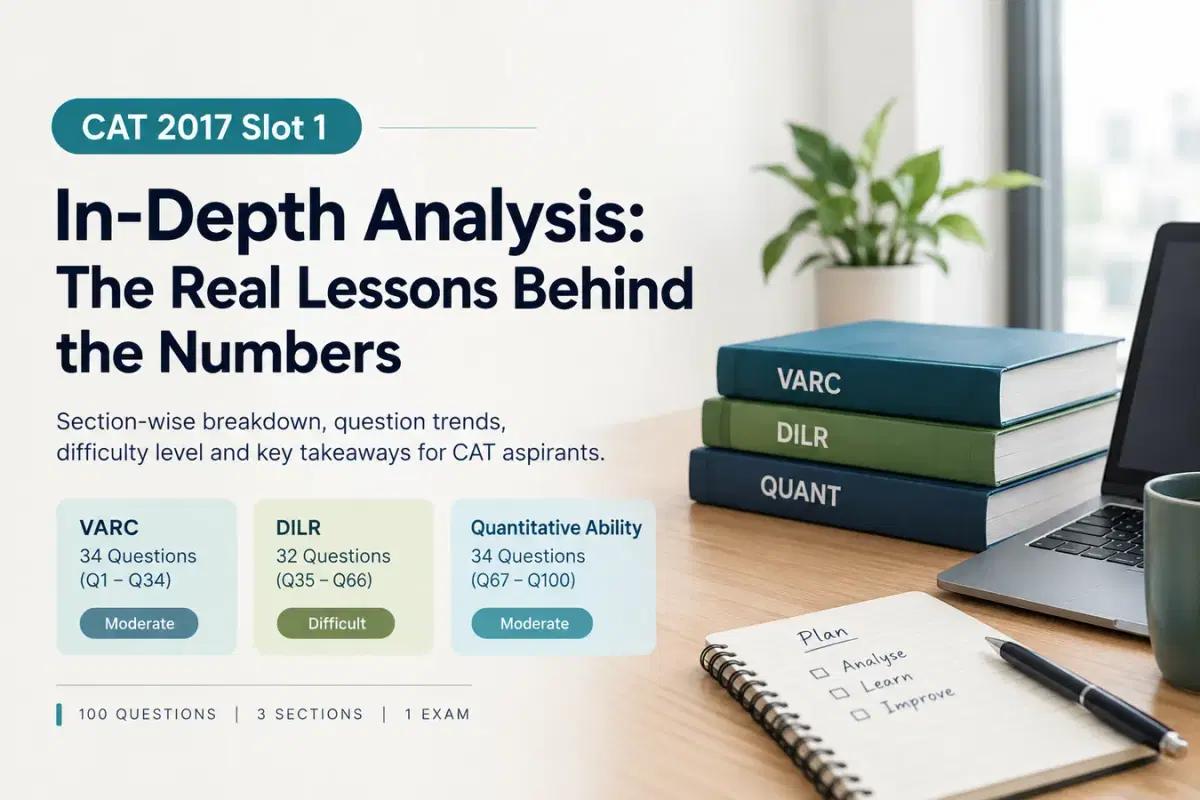
QUICK BREAKDOWN OF THE PAPER
Total Questions: 100 Time Allocation: Standard 3-section format (MCQ and Non-MCQ / TITA)
VARC: 34 Questions (Q1 to Q34) | Difficulty: Moderate Focus: Author intent, central theme, and precise option elimination.
DILR: 32 Questions (Q35 to Q66) | Difficulty: Difficult Focus: Set triage, condition mapping, and tactical decision-making.
Quantitative Ability: 34 Questions (Q67 to Q100) | Difficulty: Moderate Focus: Concept recognition, shortcut identification, and dodging time traps.
Overall Verdict: Moderate to Difficult The overall paper difficulty was driven primarily by a punishing DILR section.
SECTION 1: VARC (Questions 1 to 34)
The VARC section featured 24 Reading Comprehension questions across five passages, paired with 10 Verbal Ability questions covering Para Jumbles, Odd Sentence Out, and Para Summary. The RC passages explored non-fiction subjects including technology, evolutionary biology, consumer culture, historical cartography, and the Olympic Games.
What Happened Inside the Exam: It was not complex vocabulary or abstract prose that caught candidates off guard. The trap lay in close, deceptive answer choices. Aspirants who rushed through passages found themselves stuck between two equally tempting options. In Verbal Ability, non-MCQ Para Jumbles demanded clear logical sequencing rather than intuitive guesswork.
Strategic Takeaways for Aspirants:
Read for intent, not just information. Ask yourself why a paragraph exists and where the author changes tone.
Eliminate before you select. Spotting a single logical flaw in an option is much safer than picking one that sounds right.
Build reading stamina across unfamiliar genres. If you usually read business or technology, make a deliberate effort to read history and philosophy.
SECTION 2: DILR (Questions 32 to 66)
If you speak to anyone who wrote CAT 2017, they will remember Slot 1 for one thing: DILR.
The section presented 8 distinct sets (32 questions) covering complex employee allocations, rural schooling data, percentile benchmarks, airline routes, and platform arrangements. Many of these sets featured layered conditions requiring extensive setup work before a single question could be answered with confidence.
What Happened Inside the Exam: This section was not a test of raw math; it was a test of triage. Candidates who plunged into the very first set they saw and spent 15 minutes grinding with zero answers to show were shaken. Meanwhile, students who spent the first four to five minutes calmly surveying all eight sets to identify the three or four cleanest ones walked away with strong percentiles on modest raw scores.
Strategic Takeaways for Aspirants:
Enforce the Two-Minute Rule. Read a set's initial conditions for two minutes. If the grid or logic feels murky, walk away immediately.
Never attempt to solve every set. Solving 3 to 4 sets with clean accuracy has historically put aspirants comfortably into the 98+ percentile zone in tough DILR slots.
Leave your ego at the door. Do not turn any puzzle into a personal battle. Knowing when to quit a set is a scoring skill.
SECTION 3: QUANTITATIVE ABILITY (Questions 67 to 100)
Following the shock of DILR, Quant provided solid scoring opportunities for candidates with clean fundamentals. The 34 questions covered core areas: Arithmetic (Percentages, Time and Work, Time-Speed-Distance, Ratios), Basic Algebra, Plane and Coordinate Geometry, and select Modern Math topics like Progressions and Combinatorics.
What Happened Inside the Exam: The mathematics itself was approachable, but the section included deliberate time sinks. Certain problems tempted students into pages of algebra when a simple value-substitution or option check could have settled the answer in under a minute. Candidates who skipped lengthy multi-variable problems and swept through standard arithmetic questions scored very comfortably.
Strategic Takeaways for Aspirants:
Run a two-round system. Round 1 should be for questions you can solve under 90 seconds. Round 2 is for familiar problems that require two to three minutes of calculation.
Focus on concept recognition over formula memorization. You need to identify why a specific approach works within 15 seconds of reading the prompt.
Treat Arithmetic as your baseline anchor. Even as CAT question patterns shift, strong arithmetic skills remain the most reliable path to a high Quant percentile.
THE FINAL TAKEAWAY
CAT 2017 Slot 1 proves that CAT is fundamentally an exam of decision-making under time pressure, not a test of infinite knowledge.
High percentiles are built on three operational habits:
Smart selection: Investing your limited minutes only into high-probability questions and sets.
Fast exits: Cutting your losses instantly when a solution path stalls.
Accuracy protection: Understanding that a disciplined paper with fewer attempts will always beat a rushed paper loaded with negative marks.
Use past papers like CAT 2017 as mock strategy labs. Time yourself, practice your scanning, and build the confidence to leave bad questions behind. That is where percentiles are won.
CAT 2017 Slot 1 In-Depth Analysis: The Real Lessons Behind the Numbers
Every serious CAT aspirant eventually lands on the previous years' papers. But solving a past paper isn’t just about checking your score—it’s about understanding exam psychology: how IIMs balance question load, where the traps are laid, and how smart candidates protect their percentiles.
CATXATSNAPIIMB-School